|
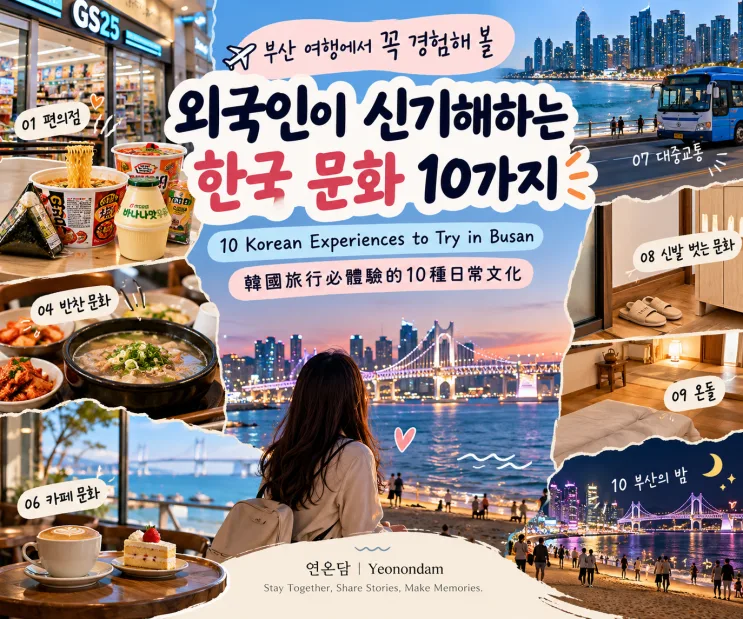
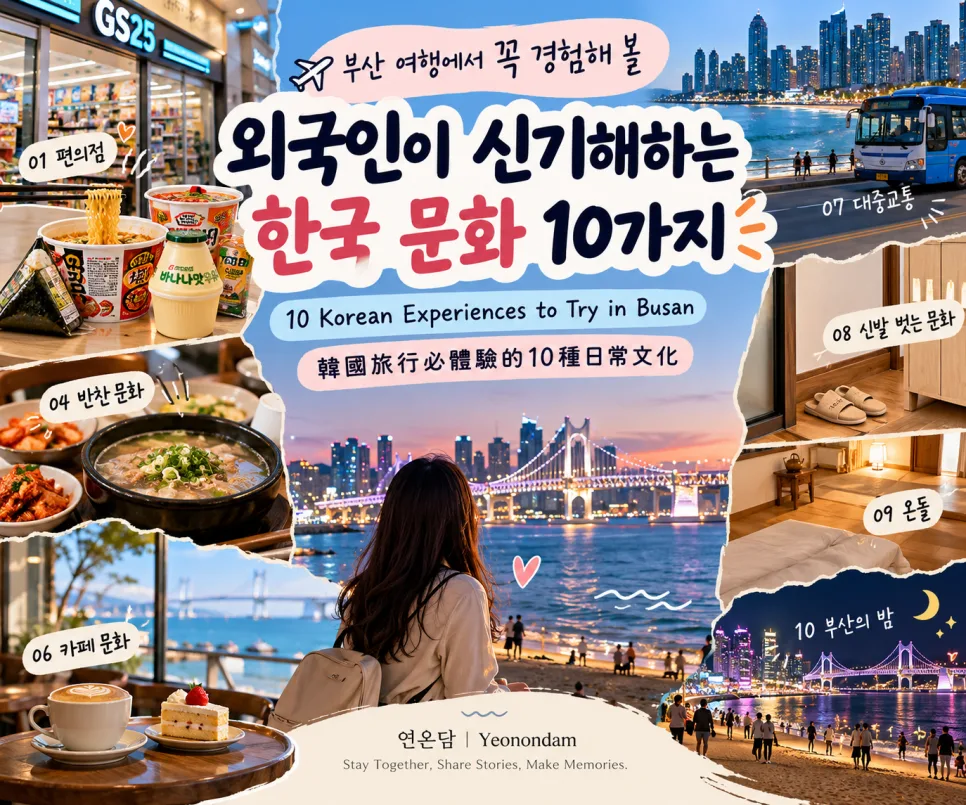
BUSAN TRAVEL NOTE · KOREAN LIFESTYLE Korean Culture Guide: 10 Everyday Surprises for Overseas Visitors Everyday Korean Life to Experience on Your Busan Trip 10 Everyday Korean Experiences to Try in Busan 10 Everyday Cultural Experiences to Try in South Korea: An Independent Traveler’s Guide to Busan |
This Korean culture guide starts in Busan, South Korea, where famous sights like Gwangalli Beach, Haeundae, and Gamcheon Culture Village usually top travelers’ lists.
But for international visitors, even the convenience stores, restaurants, and cafés that locals use without a second thought can become memorable travel experiences.
Trying food you’ve seen in Korean dramas, picking out convenience store snacks, and strolling along brightly lit streets late into the evening.
What feels like an ordinary day to a Korean local can become a highlight someone remembers long after their trip.
Of course, these experiences aren’t exclusive to South Korea. Travelers from places like Taiwan and Hong Kong, with their extensive convenience store networks and public transportation, may find plenty that feels familiar.
Still, Korea’s food, spaces, and daily routines give those familiar experiences a different flavor.
Whether you’re exploring Busan with friends from overseas or hoping to get a feel for everyday Korean life, here are 10 Everyday Korean Cultural Experiences to Enjoy in Busanto add to your trip.
|
Traditional Chinese A trip to South Korea isn’t just about sightseeing, shopping, and food. Everyday Korean life can be a fascinating part of the experience, too. From convenience stores and Korean fried chicken delivery to restaurant side dishes, cafés, and Gwangalli’s nighttime views, here are 10 everyday cultural experiences worth trying in Busan! |
10 Everyday Korean Experiences in Busan at a Glance
|
No. |
Korean Cultural Experience |
Where to Try It in Busan |
|
01 |
Convenience Stores |
Pick up snacks to enjoy by the sea at Gwangalli |
|
02 |
Food Delivery |
Share fried chicken and bunsik, casual Korean snack foods, at your accommodation |
|
03 |
Restaurants Without Tipping |
Try dwaeji gukbap, pork and rice soup; milmyeon, chilled wheat noodles; and eomuk, Korean fish cakes |
|
04 |
Banchan, Korean Side Dishes |
Kimchi, kkakdugi—cubed radish kimchi—and chives at a gukbap restaurant |
|
05 |
Table Call Buttons |
Neighborhood restaurants and Korean barbecue spots |
|
06 |
Café Culture |
Ocean-view cafés overlooking Gwangan Bridge |
|
07 |
Transit Cards |
Take the subway to Seomyeon and Nampo-dong |
|
08 |
Taking Off Shoes Indoors |
The entryway of a home-style vacation rental |
|
09 |
Ondol, Korean Underfloor Heating |
A winter trip to Busan |
|
10 |
Nightlife and Evening Views |
A walk along Gwangalli Beach |
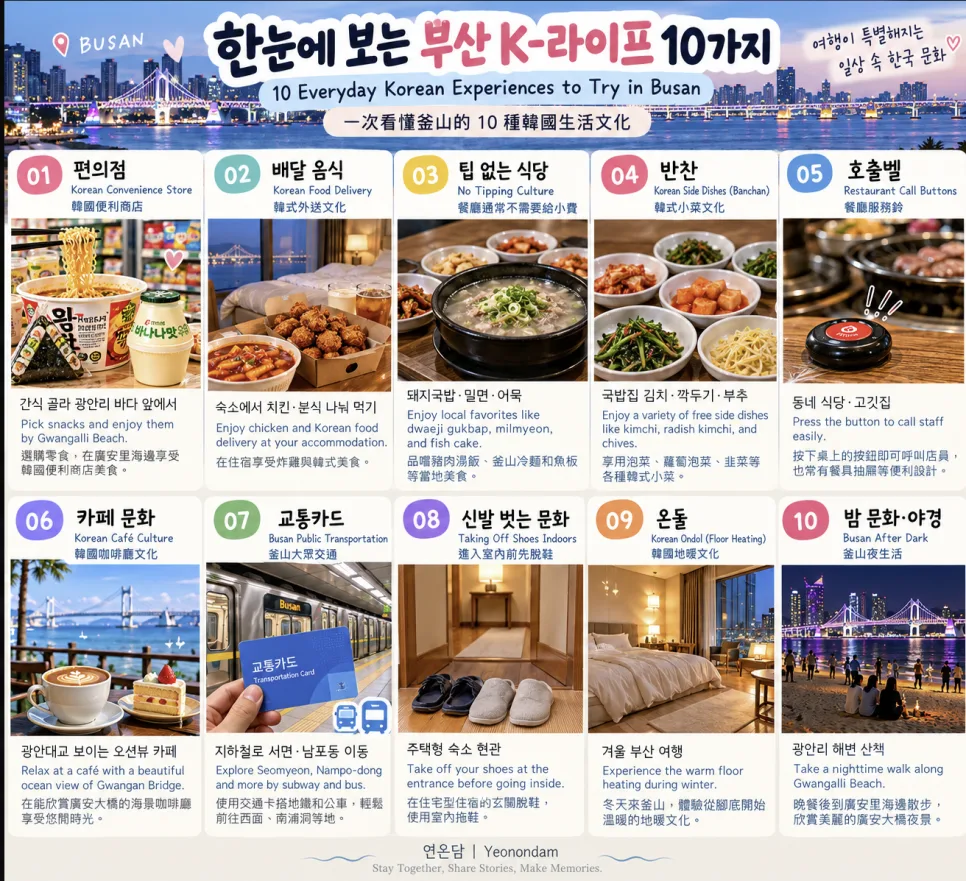
01
Start Your South Korea Trip at a Convenience Store
Korean Convenience Store Experience
Korean Convenience Stores: Try the Snacks You’ve Seen in K-Dramas
Korean convenience stores do more than sell everyday essentials. They’re also a place to discover small pleasures while traveling.
Think samgak gimbap, triangular rice balls wrapped in seaweed, cup noodles, banana milk, and all kinds of chips, sweets, and ice cream.
For international travelers, choosing and tasting something they’ve seen in a Korean drama or on social media can be part of the fun.
Taiwan and Hong Kong have plenty of convenient stores, too, but browsing for Korea-only products and unfamiliar flavors adds a fresh twist.
If you’re visiting Gwangalli, pick up your favorite snacks and a drink, then enjoy them with a sea view.
Just remember that not every convenience store has seating or a noodle-cooking station. At the beach, dispose of your trash properly.
|
Travel Tip | A Quick Reminder Try Korean instant noodles, samgak gimbap, banana milk, and Korea-exclusive snacks. Not every convenience store has a seating area or a noodle-cooking machine! |
02
Enjoy Korean Food Delivery at Your Accommodation
Korean Food Delivery Culture
Korean Food Delivery: Fried Chicken and More, Without Going Out
Ordering delivery is an everyday Korean experience worth trying at least once during your trip.
You can choose from fried chicken, pizza, tteokbokki—rice cakes in a spicy sauce—and other bunsik favorites.
After a full day exploring Busan, coming back to your accommodation and sharing a meal with friends can be a lovely part of the trip.
Korean fried chicken, a familiar sight in K-dramas, is often one of the dishes international visitors already recognize.
Keep in mind that delivery apps can be tricky for overseas travelers if they require a Korean phone number or a supported payment method.
If you plan to order delivery, check in advance that you can place an order and have the accommodation’s exact delivery address ready.
Food policies also vary by property. Some accommodations restrict outside food, where you can eat, or dishes with strong odors.
|
Travel Tip | A Quick Reminder Korea has plenty of delivery options, but some platforms require a Korean phone number or specific payment methods. Check your accommodation’s rules before ordering, especially restrictions on strong-smelling foods or eating indoors. |
03
Dining in South Korea Without Tipping
No Tipping Culture
Tipping Is Generally Not Expected at Korean Restaurants
If you’re visiting from a country where tipping is customary, such as the United States or Canada, paying for a meal in Korea may feel refreshingly straightforward.
At ordinary restaurants and cafés in South Korea, you don’t need to leave an additional tip.
You generally pay the prices listed on the menu, which makes meal budgeting a little easier.
In Busan, start with local favorites like dwaeji gukbap, milmyeon, and eomuk.
Famous restaurants near tourist attractions can be worth a visit, but eating at a neighborhood spot popular with locals is another great way to get to know the city.
|
Travel Tip | A Quick Reminder At regular restaurants and cafés in Korea, you generally don’t need to leave a tip. In Busan, try dwaeji gukbap, Busan-style eomuk, and milmyeon, the city’s signature chilled wheat noodles. |
04
Banchan: The Side Dishes That Arrive Before Your Meal
Korean Side Dishes – Banchan
Korean Side Dish Culture: Order a Main, Enjoy an Array of Accompaniments
Banchan are another part of Korean restaurant culture that often catches international visitors’ attention.
Order a main dish, and you may find kimchi, kkakdugi, namul—seasoned vegetables—and other small side dishes arriving alongside it.
At Busan’s dwaeji gukbap restaurants, accompaniments often include kkakdugi, kimchi, and chives.
You can also adjust your dwaeji gukbap to taste with saeujeot, salted fermented shrimp, or other seasonings, and add chives.
Some restaurants offer free banchan refills, but policies vary by dish and establishment, so check before asking for more.
|
Travel Tip | A Quick Reminder Korean side dishes are called banchan. When eating dwaeji gukbap in Busan, try it with kimchi, kkakdugi, and chives. Some restaurants offer free side dish refills. |
05
Call Your Server with the Push of a Button
Korean Restaurant Call Buttons
Clever Korean Restaurant Features: Call Buttons and Table Drawers
At some Korean restaurants, you’ll spot a small button on the edge of the table.
It’s a call button for the staff. Press it when you’re ready to order or need something.
You may also find spoons, chopsticks, and napkins tucked into a drawer beside the table, or storage beneath your seat for your bag.
At Korean barbecue restaurants, a grill is often built into the center of the table so you can cook the meat yourself.
These little design details are a fun introduction to the practical side of Korean dining.
|
Travel Tip | A Quick Reminder Some Korean restaurants have table call buttons: press one to get a staff member’s attention. Utensils may be stored in a drawer at the side of the table, so take a look when you sit down! |
06
Korean Café Culture: More Than a Cup of Coffee
Korean Café Culture
Cafés in Gwangalli: Sip Coffee with a Sea View
In Korea, cafés aren’t just places to grab coffee.
They’re places to catch up with friends, take photos, work on a laptop, or enjoy a quiet break.
In Busan, I’d especially recommend café-hopping around Gwangalli.
Settle into a café with Gwangan Bridge framed in the window, sip your coffee, and try a distinctive dessert without rushing.
An ordinary afternoon spent looking out at the sea can become one of your favorite Busan memories.
Gwangalli has cafés with all kinds of atmospheres, so finding one that suits your mood is part of the fun.
|
Travel Tip | A Quick Reminder Gwangalli has plenty of ocean-view cafés overlooking Gwangan Bridge. Leave an afternoon free for coffee, dessert, and a leisurely look at Busan’s sea. |
07
Explore Busan with a Single Transit Card
Busan Public Transportation
Busan Public Transit: Explore the City by Subway and Bus
Busan’s subway and bus network can take you to many of the city’s attractions.
With an eligible transit card, you may also receive transfer discounts when the applicable conditions are met.
Head from Gwangalli to Seomyeon for shopping, or travel to Nampo-dong and Jagalchi Market to explore Busan’s older streets.
The subway connects major visitor areas, making it a useful starting point for planning your route, even on your first trip.
Before you arrive, check where to buy and reload your transit card and which payment methods are accepted.
Some commuter passes and tourist transit passes used in Seoul, South Korea, aren’t valid in Busan, so don’t assume yours will work.
|
Travel Tip | A Quick Reminder Busan’s subway and buses are convenient for independent travelers. An eligible transit card can give you transfer discounts when conditions are met. Some Seoul-only transit passes cannot be used in Busan. |
08
Taking Off Your Shoes Before Entering a Korean Home
Taking Off Shoes Indoors
Korean Indoor Etiquette: Leave Your Shoes at the Door
In Korean homes, it’s customary to take off your shoes in the entryway before stepping inside.
The habit is closely tied to a home life that traditionally involves sitting and spending time on the floor.
Many households in Taiwan and Hong Kong also remove shoes indoors, so this may already feel familiar.
Still, Korea’s entryway layouts, indoor slippers, and floor-centered routines can offer a new perspective while you travel.
If you’re staying in a Korean home or home-style rental, read the check-in instructions and follow the indoor house rules.
|
Travel Tip | A Quick Reminder At Korean home-style accommodations, you’ll usually need to remove your shoes in the entryway. Follow the property’s check-in guide when using the indoor spaces. |
09
Ondol: Korean Warmth That Starts Underfoot
Korean Ondol – Floor Heating
Korean Underfloor Heating: Winter Comfort from the Ground Up
Ondol is one of the everyday traditions that makes winter in Korea feel distinctive.
Traditional ondol warms the floor from below. In modern homes, that tradition continues through systems such as hot-water underfloor heating.
Coming in from the cold and relaxing on a warm floor can feel wonderfully different if you’re used to radiators.
If you visit Busan in winter, take a little time to notice this side of Korean indoor life.
Not every accommodation has ondol or underfloor heating, though, so check the amenities before booking.
|
Travel Tip | A Quick Reminder Korea’s traditional floor-heating system is called ondol. Underfloor heating is common in modern Korean homes and especially cozy in winter. Not every accommodation has it, so confirm before booking. |
10
Busan After Dark: Plenty to Enjoy Beyond Sunset
Busan After Dark
Busan Nightlife: Don’t Miss Gwangan Bridge After Dark
In Korea’s big cities, there’s plenty to enjoy after the sun goes down.
In Busan, Gwangalli is especially inviting at night.
After sunset, Gwangan Bridge lights up, while visitors continue to fill the cafés and restaurants around the beach.
After dinner, take a walk along Gwangalli Beach and finish your day watching the illuminated bridge.
It’s a different side of Busan from the one you see in daylight.
Gwangalli is one of Busan’s signature beach destinations, especially for a relaxed walk with friends, a partner, or family.
|
Travel Tip | A Quick Reminder Gwangalli isn’t just about daytime sea views. Gwangan Bridge looks beautiful lit up at night, too. Walk along the beach after dinner to soak up Busan’s evening atmosphere. |
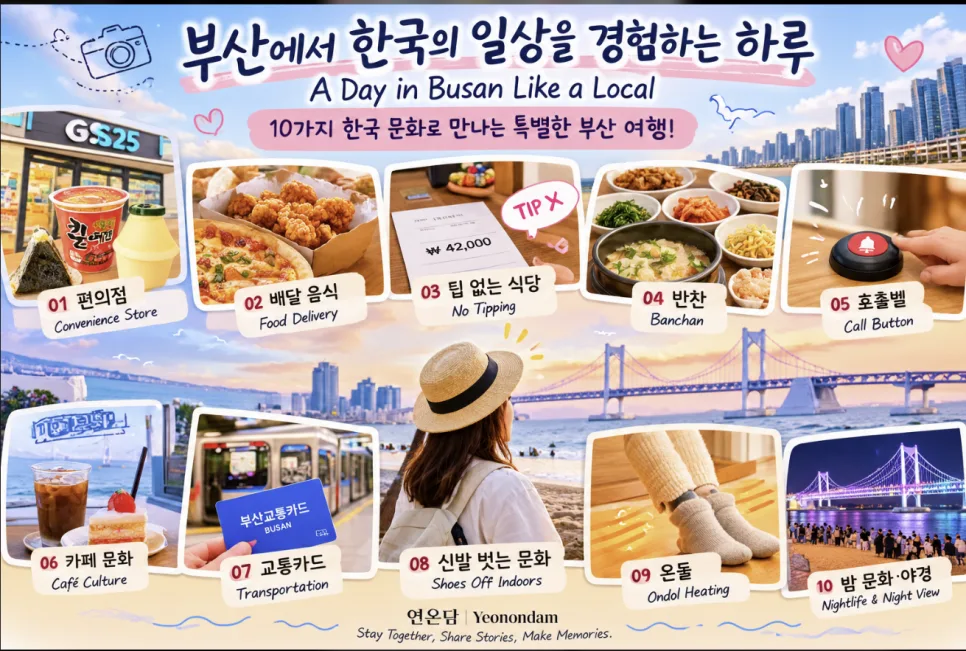
A Korean Culture Guide to a Relaxed Day in Busan
A Day in Busan Like a Local
A One-Day Itinerary for Everyday Life in Busan
You don’t have to tick off every famous attraction to have a great trip to Busan.
Start the morning with Busan-style dwaeji gukbap, then spend a leisurely afternoon at a Gwangalli café.
In the evening, walk by the sea and pick up your favorite convenience store snacks before heading back to your accommodation.
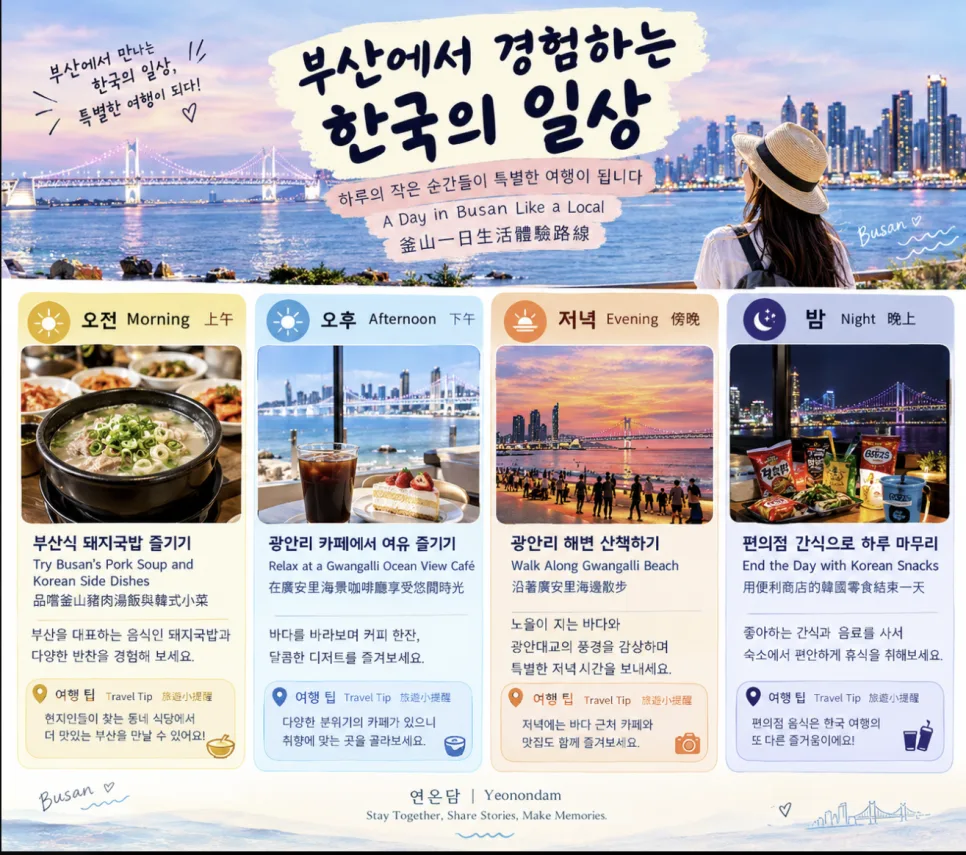
|
Morning Morning | Start of the Day |
Try dwaeji gukbap and banchan at a local Busan restaurant Enjoy dwaeji gukbap and Korean side dishes at a neighborhood restaurant in Busan |
|
Afternoon Afternoon | A Leisurely Break |
Enjoy coffee and dessert at an ocean-view café in Gwangalli Stop at a Gwangalli seaside café for coffee and dessert |
|
Evening Evening | Around Sunset |
Walk along Gwangalli Beach and admire Gwangan Bridge lit up at night Stroll along Gwangalli’s waterfront for nighttime views of Gwangan Bridge |
|
Night Night | Wind-Down Time |
Pick out Korean convenience store snacks and relax at your accommodation Choose Korean snacks at a convenience store, then unwind back at your accommodation with your travel companions |
Travel is about more than landmark attractions. There’s real pleasure in seeing how the people of a city go about an ordinary day.
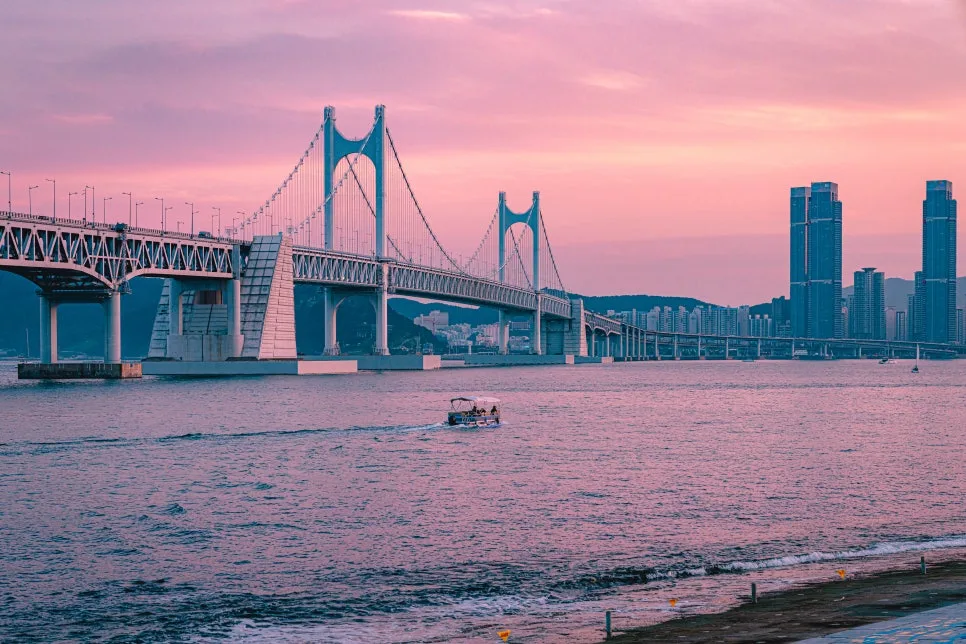

Slow Down in Busan with Yeonondam
Yeonondam | YEONONDAM
Make More Time for Each Other on Your Busan Trip
Stay Together, Share Stories, Make Memories.
If you want to enjoy both everyday Busan life and the sea at Gwangalli, where you stay matters, too.
Yeonondam is a space designed to make your Gwangalli trip more comfortable and enjoyable.
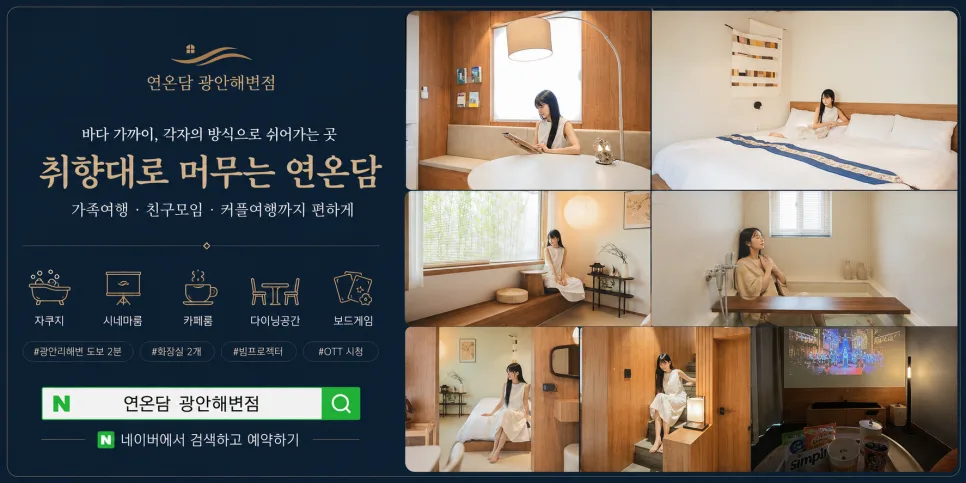
|
Yeonondam Gwangalli Beach Yeonondam Gwangalli Beach · Beach Location This accommodation is about a 2-minute walk from Gwangalli Beach. With 2 bedrooms, a living room, and a dining area, plus a cinema room, Jacuzzi, and board games, it’s a welcoming option for families and groups of friends. Standard occupancy is 4 guests, with a maximum of 10. Check-in: 16:00 / Check-out: 12:00 About a 2-minute walk to Gwangalli Beach Cinema room, Jacuzzi, and board games Traditional Chinese About a 2-minute walk from Gwangalli Beach, this accommodation has 2 bedrooms, a living room, a dining area, a cinema room, a Jacuzzi, and board games. Standard occupancy is 4 guests, with a maximum of 10, making it a good fit for trips with friends or family. Check-in: 16:00 / Check-out: 12:00. |
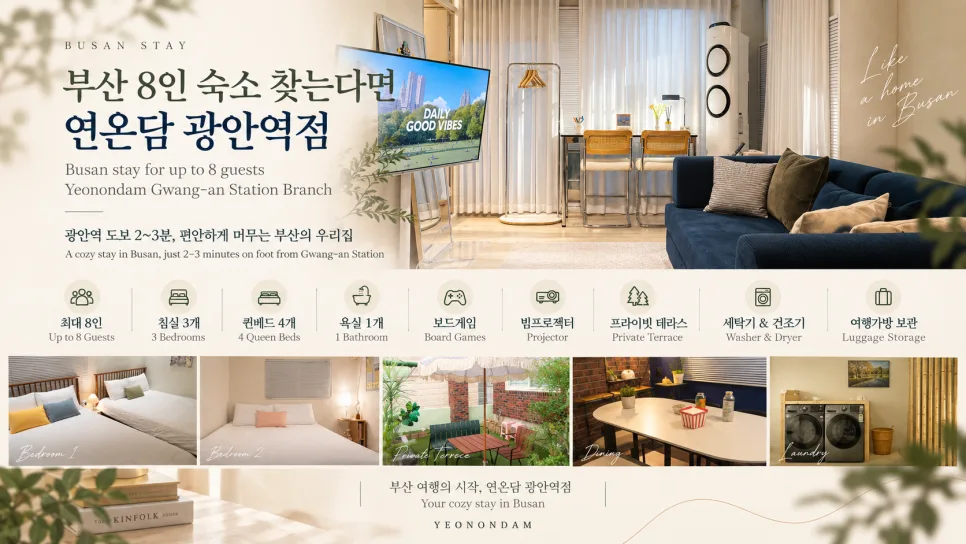
|
Yeonondam Gwangan Station Yeonondam Gwangan Station · Station Location About a 3-minute walk from Gwangan Station, this accommodation is a convenient base for exploring Busan by subway. It has 2 bedrooms and 3 queen-size beds, with room for up to 6 guests. Gwangalli Beach is about a 10–15-minute walk away. Check-in: 15:00 / Check-out: 11:00 About a 3-minute walk to Gwangan Station 2 bedrooms and 3 queen-size beds Traditional Chinese About a 3-minute walk from Busan’s Gwangan subway station and a 10–15-minute walk from Gwangalli Beach, this accommodation has 2 bedrooms and 3 queen-size beds. It sleeps up to 6 guests and suits travelers planning to explore Busan by subway. Check-in: 15:00 / Check-out: 11:00. |
Frequently Asked Questions
General Travel Information
|
Q. Do I need to tip at restaurants in South Korea? At ordinary restaurants and cafés, you don’t need to leave an additional tip. You generally pay the prices shown on the menu. |
|
Q. Can international visitors use Korean delivery apps? Some apps require a Korean phone number or specific payment methods. Before ordering, check the app’s registration and payment requirements and confirm your exact delivery address. |
|
Q. Can I use my Seoul transit pass in Busan? Seoul-only commuter passes and some tourist transit passes cannot be used in Busan. Check which transit card you’ll use in Busan and how to reload it before your trip. |
Yeonondam Accommodation Information
|
Q. What’s the difference between Yeonondam Gwangalli Beach and Yeonondam Gwangan Station? Yeonondam Gwangalli Beach is about a 2-minute walk from the beach, making it a good fit for seaside strolls and nighttime views. Yeonondam Gwangan Station is about a 3-minute walk from Gwangan Station, making it convenient for subway trips to Seomyeon, Nampo-dong, and other areas. |
|
Q. Can I stay at Yeonondam with a pet? Pets are not permitted at either Yeonondam Gwangalli Beach or Yeonondam Gwangan Station. |
|
Q. Can I cook or have a barbecue at the accommodation? Cooking that leaves strong odors is restricted, and barbecuing is not permitted. Check the property rules provided when booking for the full food and cooking guidelines. |
Travel Memories Can Begin with Ordinary Moments
The Best Travel Memories Are Often Made in Everyday Moments.
The Most Beautiful Travel Memories Are Often Found in Everyday Life
Experiencing everyday Korean life, spending time by the sea in Busan,
and sharing stories with the people traveling beside you.
The moments you remember longest don’t always happen at famous attractions.
A meal you shared, a café you stumbled upon, or a conversation during a walk by the sea at night—
ordinary moments can become wonderful memories, too.
We hope your day in Busan becomes that kind of memory.
Stay together, share stories, and make memories.
Stay Together, Share Stories, Make Memories.
Stay Together, Share Stories, Leave with Memories
Yeonondam | YEONONDAM
|
Yeonondam Accommodation Guidelines The cultural and travel information in this article describes general everyday practices in Korea. It is separate from Yeonondam’s accommodation policies. Yeonondam Gwangalli Beach and Yeonondam Gwangan Station are convenient bases for a Gwangalli trip. However, property rules do not allow pets, restrict outside visitors, prohibit smoking indoors, and ask guests to keep noise down after 22:00. Something that is generally acceptable elsewhere may still be restricted at the accommodation. Please review Yeonondam’s property guidelines before booking. Accommodation rules: Neither location allows pets or outside visitors. Smoking is prohibited throughout the indoor spaces. Please keep quiet after 22:00. House rules: No pets, no outside visitors, no smoking indoors, and quiet hours after 22:00 at both locations. |
|
Article Summary This Korean culture guide highlights 10 everyday experiences international travelers can enjoy in Busan: convenience stores, food delivery, dining without tipping, banchan, restaurant call buttons, cafés, transit cards, removing shoes indoors, ondol, and Gwangalli’s nighttime views. Yeonondam Gwangalli Beach is a private accommodation about a 2-minute walk from Gwangalli Beach. With a cinema room and Jacuzzi, it’s a good option for families and groups of friends, accommodating up to 10 guests. Yeonondam Gwangan Station is about a 3-minute walk from Gwangan Station, making it a convenient choice for exploring Busan by subway. |
Note: This article reflects general Korean lifestyle practices and Yeonondam’s operating information as of October 2026. Transit card conditions, delivery app payment options, and restaurant practices may change or vary by establishment, so double-check before using them.
This Busan travel article was compiled directly by the Yeonondam blog.
#BusanTravel #BusanForInternationalVisitors #InternationalTravelInBusan #KoreanCulturalExperiences #SouthKoreaTravel #GwangalliTravel #GwangalliAccommodation #GwangalliBeachAccommodation #WhereToStayInBusan #BusanGroupAccommodation #Yeonondam #YeonondamGwangalliBeach #IndependentBusanTravel #IndependentSouthKoreaTravel #KoreanCulture #Gwangalli #BusanAccommodation #KoreanCulture #BusanTravel #VisitBusan #KoreanLifestyle